
Index Funds vs Individual Stocks: What’s Best for Your Portfolio?
Explore the key differences between index funds and individual stocks to determine the best fit for your portfolio. Understand their risks, returns, and effort levels to make informed investment decisions tailored to your financial goals.
Investing in the stock market offers countless opportunities to grow your wealth. Yet, one critical decision can shape your portfolio’s long-term success—whether to invest in individual stocks or opt for index funds. Both options have distinct advantages and risks, and the right choice depends on factors such as your financial goals, risk tolerance, and the time you’re willing to dedicate to managing your investments.
This guide breaks down the key differences between index funds and individual stocks, analyzes their long-term returns, risks, and efforts, and demonstrates how they fit into various investment strategies. Plus, we’ll explore how innovative tools like Findex can support both passive and active investors in tracking and optimizing their strategies.
How Index Funds and Individual Stocks Work
Before we compare them, let’s clarify what index funds and individual stocks are and how they function within a portfolio.
Index Funds
Index funds are baskets of stocks designed to mimic the performance of a specific market index, such as the S&P 500 or Nasdaq 100. Instead of picking individual stocks, you buy into the entire index, securing broad market exposure. They are a hallmark of passive investing tools, requiring minimal effort to manage.
Examples of Popular Index Funds:
- Vanguard 500 Index Fund (VFIAX)
- Schwab Total Stock Market Index Fund (SWTSX)
Key Characteristics
Here’s what makes index funds distinct from individual stock investing:
- Diversification across numerous companies/sectors.
- Lower fees due to passive management.
- Steady, predictable long-term returns tied to market performance.
Individual Stocks
When you purchase individual stocks, you own shares in a specific company, gaining both reward potential and exposure to its specific risks. Stock investing requires thorough research and active management, making it a popular choice for those aiming to outperform the market.
Examples of Individual Stocks:
- Apple (AAPL)
- Tesla (TSLA)
- Amazon (AMZN)
Key Characteristics
Here’s what sets individual stock investing apart from index funds:
- Opportunity for outsized returns if a company performs exceptionally well.
- Increased risk due to lack of diversification.
- Requires time, knowledge, and continuous monitoring.
Comparing Long-Term Returns, Effort, and Risks
Returns Over the Long Term
Index Funds
Typically deliver stable, long-term growth, averaging 7-10% annual returns historically (after accounting for inflation). These returns align with broader market performance.
Individual Stocks
Offer the potential to surpass average market returns but can also lead to significant losses if companies underperform. Identifying high-growth stocks requires expertise and timing.
Evaluating Your Real Returns
Regardless of which path you choose, understanding your actual profit is more complex than simply looking at a "total gain" percentage. Factors like deposit timing and withdrawals can distort these figures. For a detailed framework on evaluating your investment success with institutional rigor, we recommend reading our guide on How to Measure Your Portfolio’s True Performance.
Case Study
Consider two investors over a 20-year period.
Investor A:
Chose an S&P 500 index fund and averaged 8% annual returns. An initial $100,000 investment grew to $466,095.
Investor B:
Invested $100,000 in individual stocks—50% in successful companies and 50% in declining ones. The portfolio’s uneven performance resulted in a less predictable outcome, ranging from substantial gains to possible net losses.
Key Takeaway:
While individual stocks can lead to exceptional gains, index funds provide dependable, compounding growth over the long term, making them ideal for risk-averse or beginner investors.
Effort Required
Index Funds
Are designed for convenience, making them synonymous with passive investing tools. Investors can “set it and forget it,” requiring minimal research beyond selecting a fund that aligns with their goals.
Individual Stocks
However, demand active investing efforts, such as analyzing financial statements, tracking industry trends, and monitoring company performance. For many, this level of effort requires dedication and financial literacy.
Risk Considerations
Index Funds
Mitigate risk through diversification. Even if one company within the index performs poorly, others in the fund can offset the loss.
Individual Stocks
Concentrate risk. If the company underperforms or the market crashes, you bear the full brunt.
Index funds vs. individual stocks: What suits your risk profile and return strategy best?
For a safer, lower-risk investment strategy, index funds are often favored. However, for experienced investors aiming to capitalize on opportunities, individual stocks offer higher reward potential, albeit at significantly higher risk.
It is worth noting that modern portfolio theory often encourages looking beyond a binary choice. To understand the mechanics of integrating these assets, we recommend reviewing our guide on How to Build a Balanced Portfolio With Both Index Funds and Stocks.
Case Studies on Strategy Impact
Case Study 1: Index Fund Investor (Long-Term Growth)
Susan, a 35-year-old professional, prioritizes retirement savings. She invests $10,000 annually in an S&P 500 index fund. Over 25 years, her low-cost index fund grows steadily, producing a portfolio worth $798,530 (assuming 8% annual returns).
Why Index Funds Works:
Susan’s diversified investment ensures stable growth, while the low effort required allows her to focus on her career and other priorities.
Case Study 2: Individual Stock Investor (Active Returns)
John, a 40-year-old tech enthusiast, focuses on buying and selling individual stocks, with a strong emphasis on growth companies. His careful selection of winners like Tesla and Nvidia leads to annual returns of 15% over 10 years, growing his $50,000 investment into $202,836. However, his high-risk portfolio also saw volatile periods, requiring significant time and effort to manage.
Why Individuals Stocks Works:
John’s knowledge of the tech market enabled greater returns, but this strategy required constant attention and risk tolerance.
Balancing Passive and Active Investment Strategies
No matter your strategy—passive, active, or a combination of both—having the right tools in place can make a significant difference.
For Passive Investors Using Index Funds
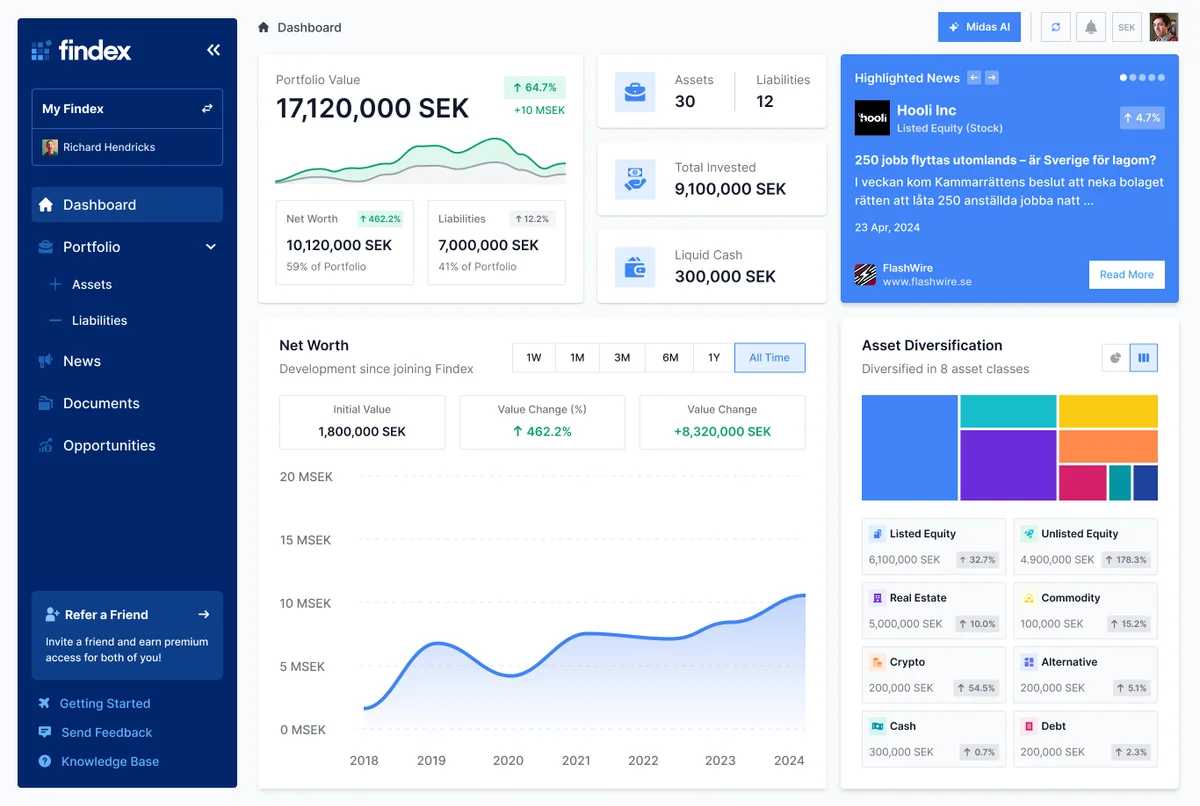
Tracking passive investments can be effortless with the right tools. Consolidating portfolio data and accessing real-time performance insights across all holdings helps investors monitor progress effectively. Simple, easy-to-read dashboards make it easier to stay on track without the need for constant micromanagement.
For Active Investors Using Individual Stocks
For investors focusing on individual stocks, advanced data visualization and analytics are essential tools for tracking performance. Monitoring stock-specific trends and using ETF investing strategies can help diversify portfolios and make more informed decisions.
The Benefits of Combining Passive and Active Strategies
Blending passive and active strategies allows investors to diversify risk by anchoring their portfolio in stable index funds while selectively adding high-potential individual stocks. This approach secures steady long-term returns, captures short-term market opportunities, and transforms raw data into practical, well-timed investment decisions.
Choosing What’s Best for Your Portfolio
When deciding between index funds and individual stocks, consider these factors:
1. Time and Effort:
Do you prefer a low-maintenance strategy, or are you willing to actively research and monitor investments?
2. Risk Tolerance:
Are you comfortable with the potential volatility of individual stocks, or do you value the stability of diversification?
3. Financial Goals:
Are you seeking predictable, long-term growth (index funds) or aiming to outperform the market (stocks)?
Pro Tip: Combine Index Funds and Individual Stocks for a Balanced Portfolio
Many investors adopt a hybrid approach, combining index funds for stability and individual stocks for growth opportunities.
Making the Right Investment Choice for Your Future
Both index funds and individual stocks have their merits, offering unique paths to portfolio success. Whether you lean toward passive investing with broad market exposure or active strategies targeting high-growth potential, the ultimate choice depends on your personal financial story.
And remember, no matter which route you choose, tools like Findex can provide the clarity and control needed to achieve your investment goals.
Whether you choose a passive or active approach, it’s all about keeping your strategy on track.
Related blogs to "Index Funds vs Individual Stocks: What’s Best for Your Portfolio?":
Your Ultimate Guide to Navigating the Stock Market
How to Build a Balanced Portfolio With Both Index Funds and Stocks
Keep reading
Related guides
How Private Markets Work: An Investor’s Guide to Understanding and Investing in Alternative Assets
Learn how private markets work—from private equity to real assets. Discover how they differ from public markets, what risks they carry, and how investors can access them today.
How Do I Access Private Market Investments as an Individual Investor?
Access to private markets is more available than ever, but management requires precision. Compare access strategies, understand persistent barriers, and learn to track and oversee private assets effectively.
What Are the Risks of Private Market Investments? A Guide for Modern Investors
Private market investing offers unique opportunities but requires disciplined oversight. Learn to manage illiquidity, valuation lag, and reporting complexity with the right tools.
Your complete net worth, finally in one place.
Join investors using Findex to consolidate, track, and grow their portfolios. One view of everything you own.
No payment information required.