

Angel Investing vs. Venture Capital: A Founder’s Guide to Raising Capital
Discover the key differences between angel investing & venture capital. Learn how to pick the right funding path to grow your startup successfully.

For founders, securing the right type of funding is crucial to turning ideas into scalable businesses. A well-chosen funding path can unlock growth, open new markets, and solidify your vision. However, the wrong option may lead to ownership dilution or misaligned goals.
Angel investing and venture capital (VC) represent two essential funding methods in the startup ecosystem. Each supports businesses at different stages and offers distinct advantages and challenges. This guide explores the differences, benefits, and considerations to help you choose the right one for your startup.
Understanding the Startup Funding Landscape
Understanding the startup funding landscape is essential before exploring angel investing and venture capital. Startup capital typically progresses through distinct stages.
1. Bootstrapping:
Initial self-funding from personal savings or contributions from friends and family.
2. Seed funding or angel investing:
Early investment to validate the idea, build prototypes, and enter the market.
3. Venture capital:
Structured funding for scaling operations, increasing market share, or preparing for IPOs.
4. Private equity and beyond:
Late-stage investments focused on profitability, expansions, and acquisitions.
Angel investing and venture capital often intersect in the transition from idea validation to growth. Understanding your current stage and funding needs is essential for selecting the right option.
What is Angel Investing?
Angel investing involves wealthy individuals who invest their personal funds in startups, typically during the early stages. Beyond money, angel investors often bring value in the form of expertise, mentorship, and professional networks.
Who Are Angel Investors?
Angel investors are often accomplished entrepreneurs, senior executives, or industry professionals with a strong commitment to driving innovation. Their investment focus typically aligns with sectors they possess deep expertise or a personal passion for. Key characteristics of angel investors include:
- Operate independently or within syndicates/networks.
- Accept high risks for the chance of early-stage rewards.
- Build personal relationships with founders, offering personalized guidance.
Typical Angel Investment Structures
Angel investors employ adaptable deal structures meticulously designed to meet the unique requirements of startups.
Equity Investments:
Providing funds in exchange for ownership stakes, typically between 10% and 25%.
Convertible Notes (or SAFEs):
Convertible debt that transitions into equity during later funding rounds, often at a discount.
Pros and Cons of Angel Investing
Pros
Early-stage support:
Ideal for startups with limited revenue or just a prototype.
Flexibility:
Deal terms are typically founder-friendly and adaptable.
Mentorship:
Angels provide industry expertise and operational advice.
Cons
Smaller investment amounts:
Typically $25,000–$500,000 per investor, which may not be enough for capital-heavy businesses.
Limited scalability:
Individual angels may lack the network or financial capacity to support long-term growth.
What is Venture Capital?
Venture capital offers structured funding for startups with proven growth potential. VC firms pool funds from institutional and private investors, prioritizing aggressive scaling strategies.
How Do Venture Capital Firms Operate?
Venture firms allocate raised capital into startups in return for equity stakes, aiming for significant returns. VC firms rely on detailed due diligence and expect startups to demonstrate strong performance metrics.
Stages of VC Funding
Venture capital investments typically progress through a series of structured funding rounds, each designed to meet specific development milestones.
1. Seed/Series A Funding:
Supports product validation and early market entry.
2. Series B Funding:
For scaling operations, enhancing technology, or expanding marketing efforts.
3. Series C (and beyond):
For market dominance, acquisitions, or IPO preparation.
Pros and Cons of Venture Capital
Pros
Large funding amounts:
Multi-million-dollar investments are suitable for scaling aggressively.
Networks and expertise:
VCs offer access to top-tier advisors, partners, and industry contacts.
Exit pathways:
Guidance toward IPOs, acquisitions, or other high-value exits.
Cons
Significant equity dilution:
VCs demand larger equity stakes, reducing founder ownership.
High-pressure focus on fast growth:
The emphasis on returns can lead to challenges, such as overexpansion or misaligned priorities, and may conflict with your vision.
Loss of autonomy:
Founders may surrender decision-making power to VCs, introducing potential conflicts.
Comparing Angel Investing and Venture Capital
Choosing between angel investing and venture capital requires a clear understanding of their distinct roles and benefits. By identifying your specific funding requirements and growth objectives, a detailed comparison can help determine which option aligns best with your startup's needs.
To that end, this overview provides a concise breakdown of the core differences between these approaches:
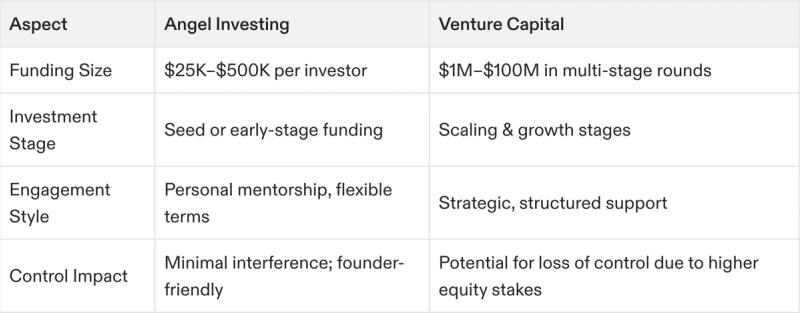
Angel investing suits startups validating early concepts, while venture capital supports businesses ready to scale aggressively.
How to Decide Between Angel Investing and Venture Capital
To choose between angel investing and venture capital, evaluate your startup’s stage and funding needs. Ask yourself the following questions.
1. How Much Funding Do You Need?
Angel Investing:
Works for startups needing smaller amounts (under $1 million).
Venture Capital:
Fits businesses requiring significant funding ($2 million or more).
2. Where Is Your Company In Its Growth Stage?
Angel Investors:
Excel at supporting startups in pre-revenue stages or testing prototypes.
Venture Capitalists:
Expect traction, revenue growth, and scalable business models.
3. How Much Ownership Are You Willing to Sacrifice?
Angel Investing:
Offers friendlier terms with less equity dilution.
Venture Capital:
Often demands significant stakes and decision-making influence.
Real-World Funding Scenarios
Angel Investing Example:
A pre-seed fintech startup requires $300,000 to refine its prototype and pilot market fit.
Venture Capital Example:
A SaaS company generating $5 million ARR seeks $10 million to scale operations nationally.
How to Attract Angel Investors and VCs
Regardless of your choice, preparation is crucial. Here's how to approach each funding route effectively.
Preparing for Angel Investors
1. Craft a compelling pitch:
Focus on your problem-solving approach and unique value proposition.
2. Show market opportunity:
Clearly demonstrate how your idea addresses an unmet need with growth potential.
3. Leverage platforms:
Use tools like AngelList or local angel networks to connect with relevant investors.
Preparing for Venture Capital
1. Highlight clear metrics:
Back your pitch with KPIs such as CAC, lifetime value, or revenue growth.
2. Demonstrate scalability:
Show how VC funding will drive your business toward exponential growth.
3. Tap into networks:
Engage with venture capital associations or attend pitch events to meet potential investors.
Exploring Alternative Funding Options
If angel or VC funding doesn’t align with your needs, explore other financing pathways.
Venture Debt:
Non-dilutive loans for startups with stable cash flow.
Crowdfunding:
Platforms such as Kickstarter facilitate the collection of small financial contributions from a wide pool of backers.
Revenue-Based Financing:
Repay based on revenue percentages each month.
Common Fundraising Pitfalls to Avoid
Fundraising can feel like a marathon, but there are common pitfalls you can avoid to improve your outcomes:
1. Raising too much or too little:
Maximize equity retention by raising only the capital necessary to achieve critical milestones.
2. Choosing the wrong investors:
Ensure alignment between your goals and investors’ priorities.
3. Lack of transparency:
Effectively articulate your equity structure, cap table, and financial projections by leveraging advanced cap table management tools.
Building a Funding Path Aligned With Your Vision
Selecting between angel investing and venture capital requires carefully assessing your funding needs, growth trajectory, and long-term vision. By understanding the trade-offs and preparing well, you can secure the right funding to drive your venture’s success.
Next steps? Network, refine your pitch, and identify investors aligned with your goals. Utilize cap table management software to maintain transparency and stay prepared throughout the process.
Related blogs about Angel Investing and Venture Capital:
Keep reading
Related guides

Growth-Stage Valuation Benchmarks (2026): Grounded in 2025 Data
Discover 2025 growth-stage company valuation benchmarks, including ARR multiples, capital efficiency, and trends in SaaS, fintech, AI, and marketplaces, to support better-informed valuation decisions in 2026.

Capital Opportunities for Startups Raising in the EU
This guide analyzes capital opportunities for EU startups in 2025, covering regional trends and investor expectations for successful fundraising.

How Venture Debt Works (Explained for Founders)
A guide to venture debt for founders: explore its structure, benefits, risks, and key terms. Learn when to use it and how to integrate it into your funding strategy.
See Findex for companies in action
Book a personalised walkthrough — we'll show you how Findex streamlines cap table, shareholder communication, and investor reporting.
- White-glove onboarding for your team
- Branded investor portal in under 48 hours
- No setup fees — pay only when you scale