
Sweden's Election Leaves Bank Tax Risk in Limbo as Final Count Runs to Thursday
Sweden's razor-thin election left a bank tax proposal in doubt, with Swedbank, Handelsbanken and SEB shares rallying on reduced political risk.

Sweden's general election on September 13 produced a three-seat lead for the center-left opposition bloc led by Magdalena Andersson, with roughly 95% of votes counted and the final tally not expected until later this week. Swedbank shares jumped as much as 2.7% in the days after the vote, their largest single-session gain since June, while Handelsbanken and SEB each added 1.5%, as investors bet the narrow margin makes a proposed bank tax harder to pass.
What happened
- The Sweden Democrats, the largest party in outgoing Prime Minister Ulf Kristersson's right-wing bloc, fell to 17.6% of the vote, their first decline in 16 years in parliament.
- Late advance votes and ballots from Swedish citizens abroad, about 3% of the total, are being counted from Wednesday, September 16, with the Election Authority expecting a final result over the weekend.
- Kristersson said he would explore forming a government within a "non-socialist parliamentary majority." Andersson's path depends on cooperation between the Left Party and the Centre Party, which have so far ruled out working together.
- Parliament can hold its first vote on a new prime minister no earlier than September 29. Sweden's negative parliamentarism rule means a candidate needs fewer than 175 MPs voting against them, not a majority voting in favor.
Why it matters
The bank tax behind this week's stock moves would apply a levy of up to 9% on lenders' 2027 pretax profit, an estimated 12.6 billion kronor ($1.3 billion) in additional revenue under the Social Democrats' own proposal. Nordea analyst Andreas Håkansson said the odds of that levy now look narrow even under a Social Democrat-led government, absent broader parliamentary backing beyond a three-seat margin.
For investors holding Nordic bank stocks through an ISK or kapitalförsäkring, the tax question is not abstract. Handelsbanken, SEB and Swedbank sit among the most widely held positions on Swedish brokerage platforms, and a coalition negotiation stretching into late September means the uncertainty priced into those shares is unlikely to clear quickly.
What to watch next
- September 16-19: remaining ballots counted and the final seat allocation confirmed by the Election Authority.
- September 28-29: the new Riksdag convenes and can hold its first vote on a prime minister candidate.
- Sweden allows up to four failed prime minister votes before an extraordinary election must be called within three months. Political scientists call that scenario unlikely given how close the current bloc split is, but not impossible.
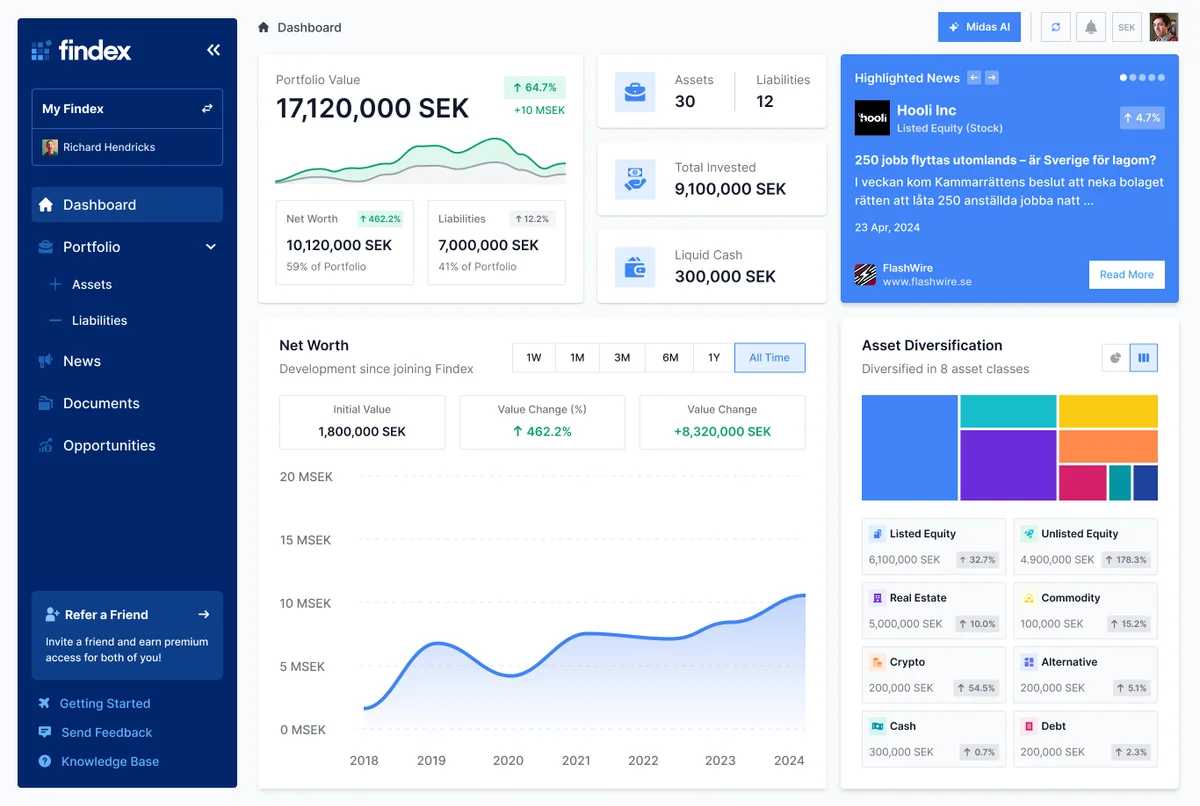
Portfolio trackers that break down exposure by individual holding, rather than a single account balance, make it easier to see how concentrated a political outcome like a bank tax vote is within a Nordic-heavy portfolio.
Keep reading
Related trends

Sweden's Riksbank Holds Rate at 1.75% for Seventh Straight Meeting
Sweden's Riksbank held its rate at 1.75% for a seventh straight meeting and kept a hike on the table if Middle East tensions push up inflation.
Nordnet Posts Record Quarter as Nordic Broker Passes 2.5 Million Customers
Nordnet's operating profit rose 33% in Q2 as the Nordic broker passed 2.5 million customers, widening its lead over rival Avanza across four markets.
Riksbanken Rate Decision: Hold at 1.75% Expected as Sweden's Economy Stays Fragile
Sweden's central bank publishes its June monetary policy report on Wednesday, with economists and markets pricing no change to the 1.75% rate.
Your complete net worth, finally in one place.
Join investors using Findex to consolidate, track, and grow their portfolios. One view of everything you own.
No payment information required.